
Table of Contents
ToggleQuick Answer: Spiders enter Ontario homes primarily because they are looking for food, shelter, moisture, and suitable places to build webs or hunt. Basements, garages, crawl spaces, closets, window areas, and other dark or undisturbed locations are common hiding spots. The most effective way to reduce spider activity is to address the conditions attracting them especially other insects, exterior entry points, clutter, moisture, and outdoor lighting while using professional pest control when spider activity becomes persistent or difficult to manage. Health Canada notes that common spiders found in Canadian homes include house spiders, wolf spiders, cellar spiders, and fishing spiders, and recommends measures such as sealing entry points, repairing screens, removing webs, reducing clutter, and controlling the insects that provide spiders with food.
Spiders are a normal part of Ontario’s environment, and many species are actually beneficial because they prey on other insects. However, that doesn’t mean homeowners want webs covering their windows, spiders appearing in bedrooms, or large numbers of spiders occupying basements, garages, patios, and other parts of the property.
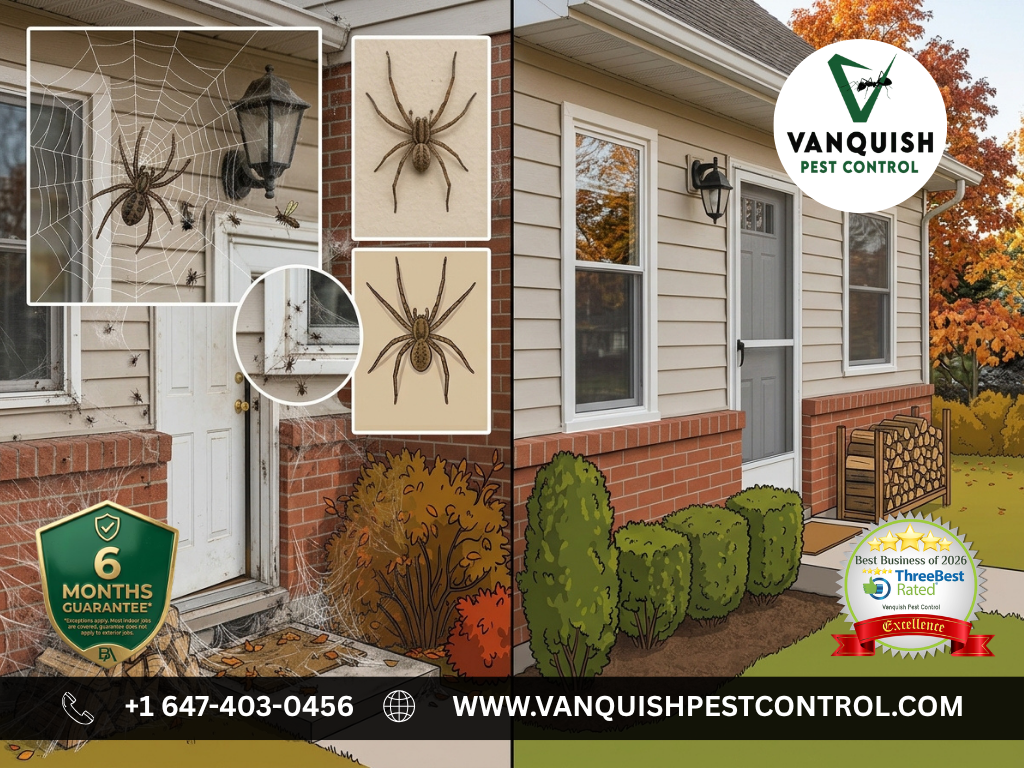
If you’re repeatedly seeing spiders inside your home, the spider itself may not be the only problem. A high spider population can sometimes indicate that your property has an abundant supply of insects for spiders to feed on. In other cases, gaps around windows, doors, foundations, vents, or other openings may be giving spiders easy access indoors.
Understanding why spiders enter homes is therefore an important part of effective spider control.
At Vanquish Pest Control, we help homeowners and businesses identify pest activity and develop practical pest management strategies based on the property and the specific pest problem. Whether you’re dealing with spiders in a basement, garage, home, restaurant, office, rental property, or commercial building, professional assessment can help determine what is attracting them and how to reduce recurring activity.
This comprehensive guide explains the most common reasons spiders enter Ontario homes, which spiders you may encounter, where they hide, how to prevent them, when professional spider control is appropriate, and what homeowners can do to maintain a less spider-friendly property.
Why Do Spiders Enter Homes?
One of the most common questions homeowners ask is:
“Why are there so many spiders in my house?”
Spiders generally enter buildings for three main reasons:
- Food
- Shelter
- Suitable environmental conditions
Unlike pests such as ants or cockroaches, spiders aren’t usually entering your home because they are attracted to human food.
Instead, they’re often following the insects that provide their food source.
If a building has plenty of flies, moths, mosquitoes, ants, earwigs, or other small insects, it may also become attractive to spiders.
Health Canada explains that spiders prey on insects and that many spiders are beneficial because they help control other pests.
This means that effective spider management often involves addressing both the spiders and the insects they are feeding on.
What Attracts Spiders to a House?
Several conditions can make your property more attractive to spiders.
1. Other Insects
This is one of the most important factors.
Spiders need food, and insects provide that food.
If you have significant activity from:
- Flies
- Moths
- Ants
- Mosquitoes
- Earwigs
- Other flying or crawling insects
spiders may find your property particularly suitable.
Reducing the underlying insect population can therefore help reduce the food supply available to spiders.
2. Exterior Lighting
Outdoor lights can attract flying insects, especially at night.
When insects gather around exterior lights, spiders may follow because they have access to an easy food source.
If you regularly find spider webs around:
- Porch lights
- Garage lights
- Exterior doors
- Windows
- Patio lighting
the lighting may be indirectly contributing to spider activity.
Health Canada recommends yellow outdoor light bulbs as one way to attract fewer insects and discourage spiders from building webs around the house.
3. Moisture
Some spider species prefer damp or cool environments.
Basements, crawl spaces, garages, utility rooms, and areas with condensation or leaks can provide suitable conditions.
Cellar spiders, for example, are commonly associated with cool, damp basements and cellar areas.
Addressing unnecessary moisture can therefore be an important part of spider prevention.
4. Clutter
Clutter creates hiding opportunities.
Boxes, stored materials, unused furniture, wood piles, and other items can provide sheltered spaces where spiders and their prey can remain undisturbed.
Keeping storage areas organized makes it easier to identify webs and pest activity early.
5. Easy Entry Points
Spiders can enter through relatively small openings.
Potential access points include:
- Gaps around doors
- Window screens
- Foundation cracks
- Utility openings
- Vents
- Gaps around pipes
- Damaged weather stripping
- Open garage doors
Sealing appropriate openings can reduce opportunities for spiders and other insects to enter.
Health Canada specifically recommends weather stripping or caulking windows and doors and repairing screens to help prevent spiders and other pests from entering homes.
Common Spiders Found in Ontario Homes
Not every spider you encounter is dangerous or requires professional extermination.
Canada has many spider species, and most are harmless to people.
Some of the spiders commonly encountered in Canadian homes include:
- House spiders
- Wolf spiders
- Cellar spiders
- Fishing spiders
Health Canada also notes that black widow spiders occur in southern areas of Canada but are much less common.
Correct identification is important before deciding how to manage a spider problem.
House Spiders
House spiders are commonly found inside buildings.
They may build webs:
- In corners
- Behind furniture
- Around windows
- Under furniture
- In quiet areas
Their presence may indicate that there are insects available for them to feed on.
Wolf Spiders
Wolf spiders are different from many web-building spiders because they actively hunt their prey rather than relying primarily on webs.
They can be relatively large and may enter homes when searching for shelter.
Health Canada notes that wolf spiders may move into homes during the fall as they look for warmer locations.
Cellar Spiders
Cellar spiders have extremely long, thin legs and are often associated with basements and other cool, damp areas.
They are generally harmless.
Reducing humidity and removing webs can help manage their presence.
Fishing Spiders
Fishing spiders are more commonly associated with waterfront environments, cottages, and areas near water.
They can be larger than many house spiders and may occasionally be encountered around suitable outdoor environments.
Are Spiders Dangerous?
For most Ontario homeowners, encountering a spider does not mean there is an immediate danger.
Health Canada states that spiders rarely bite humans and that most spiders are shy and generally avoid confrontation.
That said, homeowners should still use caution when handling spiders, especially in dark or secluded areas.
If you are concerned about a particular species, don’t handle it unnecessarily.
Professional pest identification can help determine what you’re dealing with.
Why Am I Finding Spiders in My Basement?
Basements are one of the most common places where homeowners notice spider activity.
That’s because basements can offer several things spiders like:
- Darkness
- Shelter
- Moisture
- Undisturbed areas
- Other insects
- Cracks and crevices
If spiders are repeatedly appearing in your basement, don’t focus only on removing the visible webs.
Inspect the surrounding environment.
Ask:
- Is there excessive moisture?
- Are there leaks?
- Are insects present?
- Is there clutter?
- Are foundation openings visible?
- Are windows properly screened?
- Are there gaps around pipes or utilities?
Addressing these conditions can make the basement less attractive to spiders.
Why Are There So Many Spider Webs Around My House?
Large numbers of webs can be frustrating, especially around windows, doors, porches, decks, and exterior lights.
Webs often indicate that spiders have found a suitable location with access to prey.
If insects regularly gather around your exterior lighting, spiders may build webs nearby because they can intercept those insects.
Simply removing the webs may provide temporary improvement, but if the underlying food source remains, spiders may rebuild them.
That’s why long-term spider prevention should consider the entire property rather than just visible webs.
How to Keep Spiders Out of Your House
There are several practical steps homeowners can take to reduce spider activity.
Seal Cracks and Gaps
Inspect the exterior of your home for openings around:
- Doors
- Windows
- Foundation
- Pipes
- Utility lines
- Vents
- Garage doors
Seal suitable gaps where appropriate.
Repair Window Screens
Damaged screens can provide easy access for insects and spiders.
Repair holes and make sure screens fit properly.
Reduce Outdoor Insect Activity
Since spiders feed on insects, reducing insect activity around your home can make the property less attractive.
Keep garbage covered, clean food waste, and address standing water where appropriate.
Remove Webs Regularly
Use a broom or vacuum to remove webs from appropriate areas.
Health Canada recommends physically removing spider webs when spiders are not in them.
Reduce Clutter
Keep basements, garages, storage rooms, and other areas organized.
Avoid leaving clothing, shoes, blankets, and similar items on floors for long periods.
Control Moisture
Repair leaks, improve ventilation, and address unnecessary dampness.
This is particularly important in basements and crawl spaces.
Maintain Landscaping
Keep vegetation reasonably maintained around the exterior of your home.
Overgrown vegetation can provide additional shelter for insects and spiders.
Spider Prevention Around Windows and Doors
Windows and doors are common areas for spider webs because they can provide both shelter and access to insects.
Inspect:
- Window frames
- Door frames
- Screens
- Exterior lighting
- Weather stripping
- Nearby vegetation
If spiders consistently build webs around the same entrance, there may be an underlying insect attraction or an easy entry point.
Fixing the source can be more effective than repeatedly cleaning the webs.
Spider Control for Garages
Garages can become attractive spider habitats because they are often quiet, dark, and less frequently disturbed than living areas.
Common problem areas include:
- Corners
- Storage shelves
- Garage door frames
- Boxes
- Ceiling areas
- Behind stored equipment
- Around windows
Keep stored items organized and avoid unnecessary clutter.
Regularly inspect corners and remove webs.
Also check whether insects are entering through gaps around the garage door or other openings.
Spider Control for Businesses
Spider problems aren’t limited to homes.
Commercial properties can experience spider activity around:
- Entrances
- Loading areas
- Storage rooms
- Warehouses
- Exterior lighting
- Garbage areas
- Basements
- Mechanical rooms
For businesses, visible webs can create an unprofessional appearance and negatively affect customer perceptions.
Restaurants, retail stores, offices, warehouses, property management companies, and other commercial facilities can benefit from proactive pest management.
A commercial pest control program can focus on reducing the conditions that support spider activity while addressing other insects that may be providing a food source.
Spider Control for Restaurants
Restaurants have a unique pest management challenge because food, moisture, garbage, deliveries, and customer activity can attract many types of insects.
Those insects can then attract spiders.
Potential problem areas include:
- Storage rooms
- Garbage areas
- Exterior doors
- Loading zones
- Kitchens
- Utility areas
- Outdoor patios
Restaurant pest control should therefore consider the entire pest ecosystem.
If spider activity is increasing, it may be worthwhile to investigate whether flies, ants, cockroaches, or other insects are also present.
When Should You Call a Professional Spider Control Company?
Not every spider requires professional treatment.
However, professional assistance may be appropriate when:
- Spider activity is increasing.
- Large numbers of spiders are appearing.
- Webs return quickly after removal.
- Spiders are appearing in multiple rooms.
- There is significant insect activity.
- Spiders are entering through structural openings.
- The problem continues despite prevention efforts.
- You cannot identify the pest.
- The infestation is affecting a commercial property.
- You are concerned about a particular spider species.
A professional pest control company can assess the property and determine whether the spider problem is isolated or connected to another pest issue.
Why Simply Killing Spiders May Not Solve the Problem
Suppose you find ten spiders in your basement and remove all ten.
If the basement still has:
- Moisture
- Insects
- Clutter
- Entry points
- Web-building locations
new spiders may eventually appear.
This is why successful spider management should focus on the conditions supporting spider activity.
The objective isn’t necessarily to eliminate every spider outdoors. Spiders are part of the ecosystem and can help control insects.
Instead, the goal is to reduce unwanted spider activity in areas where spiders become a nuisance or interfere with the use of your property.
Professional Spider Control in Ontario
Professional spider control in Ontario should begin with an inspection.
At Vanquish Pest Control, a property assessment can help determine:
- Where spiders are active
- Which areas have the highest activity
- Whether other insects are present
- Where spiders may be entering
- Whether moisture is contributing to the problem
- Where webs are being established
- What prevention measures may be appropriate
Once the situation is understood, an appropriate pest management strategy can be recommended.
The goal is to provide a solution based on the actual property rather than relying on a one-size-fits-all approach.
DIY Spider Control: What Homeowners Should Know
There are several non-chemical steps homeowners can take before considering pesticide treatment.
These include:
- Vacuuming webs
- Reducing clutter
- Sealing entry points
- Repairing screens
- Reducing moisture
- Controlling other insects
- Improving outdoor sanitation
- Adjusting exterior lighting
Health Canada recommends physical control and prevention measures for spider management and notes that complete chemical removal of spiders is not generally recommended because spiders are natural pest controllers.
If pesticide use becomes necessary, products must be used according to their Canadian registration and label requirements. Health Canada advises consumers to identify the pest correctly, use registered products, and follow label directions.
For persistent infestations, professional pest control can help determine the most appropriate approach.
Spider Prevention for Ontario’s Changing Seasons
Spider activity can change throughout the year.
Different species may behave differently depending on temperature, moisture, food availability, and shelter.
During warmer months, outdoor insect populations can increase, providing spiders with more food.
As temperatures change later in the year, some spiders may seek shelter in buildings.
This means seasonal pest prevention can be useful rather than waiting until spider activity becomes noticeable indoors.
Regularly inspect:
- Basements
- Garages
- Attics
- Windows
- Doors
- Foundations
- Storage areas
- Exterior lighting
Early detection can make pest management easier.
Frequently Asked Questions About Spider Control in Ontario
Why are spiders suddenly appearing in my house?
A sudden increase can be related to changes in temperature, moisture, insect activity, or access to sheltered areas. In some cases, spiders may also be entering through gaps around windows, doors, foundations, or other openings.
What attracts spiders to a house?
Food is one of the biggest factors. Spiders prey on insects, so properties with significant insect activity can provide an attractive food source.
How do I get rid of spiders in my basement?
Start by reducing clutter, removing webs, controlling moisture, sealing entry points, and addressing other insects. If spider activity continues or becomes extensive, consider a professional inspection.
Why are there so many spider webs around my windows?
Windows can provide sheltered locations close to flying insects. Exterior lighting may also attract insects, which can encourage spiders to build webs nearby.
Are spiders common in Ontario homes?
Yes. Several spider species are commonly encountered in Canadian homes, including house spiders, wolf spiders, and cellar spiders.
Are house spiders dangerous?
Most spiders found in homes are not dangerous to people. Health Canada notes that spiders generally avoid humans and rarely bite.
Does cleaning get rid of spiders?
Cleaning can help remove webs, clutter, and some food sources, but persistent spider activity may have an underlying cause that cleaning alone doesn’t address.
How can I prevent spiders from entering my home?
Seal cracks and gaps, repair screens, maintain doors and windows, reduce clutter, control other insects, and address moisture problems.
Should I use spider spray inside my home?
Pesticides aren’t always necessary. Health Canada recommends physical and preventive controls first and advises that any pesticide used in Canada must be registered and applied according to its label.
When should I hire a professional exterminator for spiders?
Consider professional help when spider activity is persistent, widespread, rapidly increasing, connected with another pest problem, or difficult to manage with normal prevention methods.
Why Choose Vanquish Pest Control for Spider Control?
When spiders repeatedly appear throughout your property, treating individual spiders may not address the underlying issue.
At Vanquish Pest Control, we take a property-focused approach to pest management.
Our team can help homeowners and businesses understand:
- Why spiders are appearing
- Where they are coming from
- What other pests may be supporting the population
- Which areas require attention
- What prevention measures can reduce future activity
We provide pest control services for residential and commercial properties and address a range of common pest problems, including spiders, ants, rodents, cockroaches, bed bugs, wasps, and other unwanted pests.
We’re also proud to have been recognized by ThreeBestRated, reflecting our commitment to professional service and customer satisfaction.
Our goal isn’t simply to remove the spiders you can see. We want to help you understand the conditions contributing to the problem and provide a practical pest management solution suited to your property.
Final Thoughts: Keep Spiders Under Control
Spiders are a natural and often beneficial part of Ontario’s ecosystem, but excessive spider activity inside your home or around your business can become a nuisance.
The key to effective spider control isn’t simply killing every spider you see.
Instead, look at the bigger picture.
Why are spiders there?
Are they finding plenty of insects to eat? Is your basement too damp? Are there gaps around doors and windows? Is outdoor lighting attracting insects? Are clutter and storage areas providing hiding places?
Addressing these conditions can help make your property less attractive to spiders.
For homeowners and businesses dealing with persistent spider activity, professional spider control in Ontario can provide a more comprehensive approach. An inspection can help identify the underlying conditions and determine whether additional pest management is necessary.
At Vanquish Pest Control, we help Ontario homeowners, restaurants, property managers, and businesses address spider and other pest concerns with professional, customized solutions.
If spiders are becoming a recurring problem in your home or business, don’t just keep removing the webs. Contact Vanquish Pest Control today for a professional pest inspection and discover what may be attracting spiders to your property.
Vanquish Pest Control — Professional pest management for a cleaner, more comfortable, pest-free property.