Table of Contents
ToggleQuick Answer: Commercial pest control in Ontario is a proactive process designed to identify, control, and prevent pests in workplaces, restaurants, warehouses, retail stores, rental properties, offices, and other commercial facilities. Effective commercial pest management goes beyond treating visible pests. It involves professional inspection, pest identification, monitoring, targeted treatment, sanitation, exclusion, documentation, and ongoing prevention. For businesses and property managers, working with a professional pest control company can help protect customers, employees, tenants, inventory, property, and business reputation.
A pest problem can develop quickly inside a commercial property.
A few cockroaches in a restaurant, mice inside a warehouse, fruit flies around a bar drain, ants in an office kitchen, bed bugs in a rental property, or wasps around a commercial entrance can all become serious concerns if they are not addressed properly.
The challenge is that pests don’t always make themselves visible.
They hide behind equipment, inside wall voids, beneath appliances, around plumbing, inside storage areas, under flooring, in ceiling spaces, and around exterior structures. By the time employees or customers notice a pest, the underlying problem may already have been developing.
That’s why commercial pest control in Ontario should focus on more than eliminating the insects or rodents that are visible.
The goal is to identify the source, understand the conditions supporting pest activity, address the infestation appropriately, and reduce the likelihood of the problem returning.
For businesses and property managers, this approach can provide a more reliable long-term pest management strategy.
What Is Commercial Pest Control?
Commercial pest control is the professional management of pest problems in businesses and commercial properties.
Unlike a simple one-time treatment, commercial pest management can involve an ongoing program based on the property’s pest risks and operational environment.
A professional commercial pest control program may include:
- Property inspection
- Pest identification
- Monitoring
- Targeted treatment
- Pest activity assessment
- Entry-point inspection
- Sanitation recommendations
- Exclusion recommendations
- Follow-up inspections
- Preventive pest management
- Service documentation
The exact approach depends on the type of property, pest, infestation level, and environmental conditions.
A restaurant, for example, has different pest risks from a warehouse or apartment building.
Why Is Commercial Pest Control Important for Ontario Businesses?
Pests can affect a business in several ways.
Customer Experience
Customers don’t expect to see cockroaches, rodents, flies, spiders, or wasps when visiting a business.
Even a single visible pest can create a negative impression.
For restaurants, cafés, hotels, retail stores, and other customer-facing businesses, pest activity can quickly become a reputation issue.
Employee Confidence
Employees also want to work in a clean and comfortable environment.
Repeated pest sightings can lead to complaints and concerns about workplace conditions.
Property Protection
Rodents and other pests can damage materials, packaging, insulation, wiring, and stored products.
Operational Disruption
An infestation may require businesses to spend time dealing with pest complaints, cleaning, repairs, product loss, or temporary disruptions.
Regulatory Considerations
Certain industries have specific requirements concerning pest prevention and documentation.
For example, Ontario’s food premises regulation requires food premises to be protected against pest entry and kept free from conditions that lead to pest harbourage or breeding. The regulation also requires records of pest control measures undertaken.
This makes professional pest management particularly important for food-service businesses.
Common Commercial Pests in Ontario
Different commercial properties experience different pest pressures.
Some of the most common include:
- Cockroaches
- Mice
- Rats
- Ants
- Wasps
- Hornets
- Fruit flies
- Other flies
- Spiders
- Bed bugs
- Silverfish
- Seasonal pests
Let’s look at some of the most important commercial pest problems.
Cockroach Control for Businesses
Cockroaches are among the most concerning pests for food-service businesses and commercial properties.
They can hide in:
- Wall voids
- Cabinets
- Behind appliances
- Under sinks
- Around plumbing
- Beneath equipment
- Storage areas
- Cracks and crevices
Seeing a cockroach during the daytime can sometimes indicate significant activity because cockroaches are commonly more active when areas are quiet and dark.
A professional cockroach inspection should look beyond the location where the insect was discovered.
The technician may assess possible food sources, moisture, harbourage areas, entry points, and other conditions supporting the infestation.
Commercial Rodent Control
Mice and rats can create significant concerns for businesses.
Rodents may enter through surprisingly small openings around:
- Doors
- Loading docks
- Foundations
- Pipes
- Utility penetrations
- Roof areas
- Damaged building materials
Signs of rodent activity can include:
- Droppings
- Gnaw marks
- Nesting materials
- Damaged packaging
- Scratching noises
- Unusual odours
- Grease marks
A successful rodent control strategy should address both the current population and the conditions that allow rodents to enter.
Fruit Fly Control for Restaurants
Fruit flies are particularly problematic for restaurants, cafés, bars, bakeries, grocery stores, and other food-service businesses.
They can reproduce in moist organic material, including buildup around drains, garbage areas, beverage stations, and equipment.
This is why repeatedly killing adult fruit flies may not solve the underlying problem.
Professional fruit fly control focuses on locating potential breeding sources and addressing the environmental conditions supporting the population.
Wasp and Hornet Control
During Ontario’s warmer months, wasps and hornets can become an important concern for businesses.
Commercial properties may have nests around:
- Rooflines
- Soffits
- Exterior walls
- Trees
- Garages
- Loading areas
- Building entrances
- Wall cavities
A particularly difficult situation occurs when a wasp colony establishes itself inside a structural void.
For example, a wasp hive may be hidden inside a brick wall cavity, with workers repeatedly entering and leaving through a small opening.
In such cases, attempting to open or disturb the structure can create unnecessary risk.
Professional pest control equipment and treatment methods can allow technicians to address difficult-to-reach infestations through appropriate access points.
Spider Control for Commercial Properties
Spiders can become noticeable around commercial entrances, exterior lighting, storage areas, warehouses, windows, and other sheltered locations.
A large amount of spider activity can sometimes indicate that other insects are available as a food source.
Therefore, commercial spider control may involve looking at the broader insect population rather than treating spiders alone.
Bed Bug Control for Rental and Hospitality Properties
Bed bugs can be especially challenging for:
- Hotels
- Motels
- Apartment buildings
- Rental properties
- Student residences
- Multi-unit housing
They can spread through luggage, clothing, furniture, and personal belongings.
Because bed bugs hide in protected locations, professional inspection is important when an infestation is suspected.
Commercial Pest Control for Restaurants
Restaurants require particularly careful pest management because they combine food, water, waste, equipment, deliveries, and high customer traffic.
Potential problem areas include:
- Kitchens
- Food storage
- Refrigeration areas
- Dishwashing areas
- Drains
- Garbage rooms
- Loading docks
- Delivery areas
- Staff rooms
- Exterior entrances
- Outdoor patios
Common restaurant pests include cockroaches, fruit flies, rodents, ants, flies, wasps, and spiders.
A professional restaurant pest control program can help identify vulnerabilities before they develop into significant infestations.
Why Drain Inspection Matters
Drains can become important pest breeding areas, particularly for small flies.
Organic buildup and moisture can create suitable conditions for fly development.
Regular cleaning and professional inspection can help identify problems early.
Garbage Management
Garbage provides food and shelter for many pests.
Businesses should:
- Keep waste containers closed
- Remove waste regularly
- Clean spills
- Maintain clean garbage storage areas
- Avoid allowing food waste to accumulate
Professional pest management can complement these sanitation procedures.
Commercial Pest Control for Property Managers
Property managers have unique responsibilities when dealing with pest problems.
A pest complaint from one tenant shouldn’t automatically be treated as an isolated incident.
Depending on the pest, it may be necessary to inspect:
- Adjacent units
- Hallways
- Garbage areas
- Basements
- Mechanical rooms
- Storage areas
- Common spaces
- Utility areas
This is especially important for pests that can move between units.
Bed Bugs in Multi-Unit Properties
Bed bugs can be particularly difficult for property managers because they can move through belongings and, in some circumstances, between nearby areas.
A professional response should include inspection, identification, treatment recommendations, and communication.
Property managers should also maintain appropriate documentation of pest activity and service.
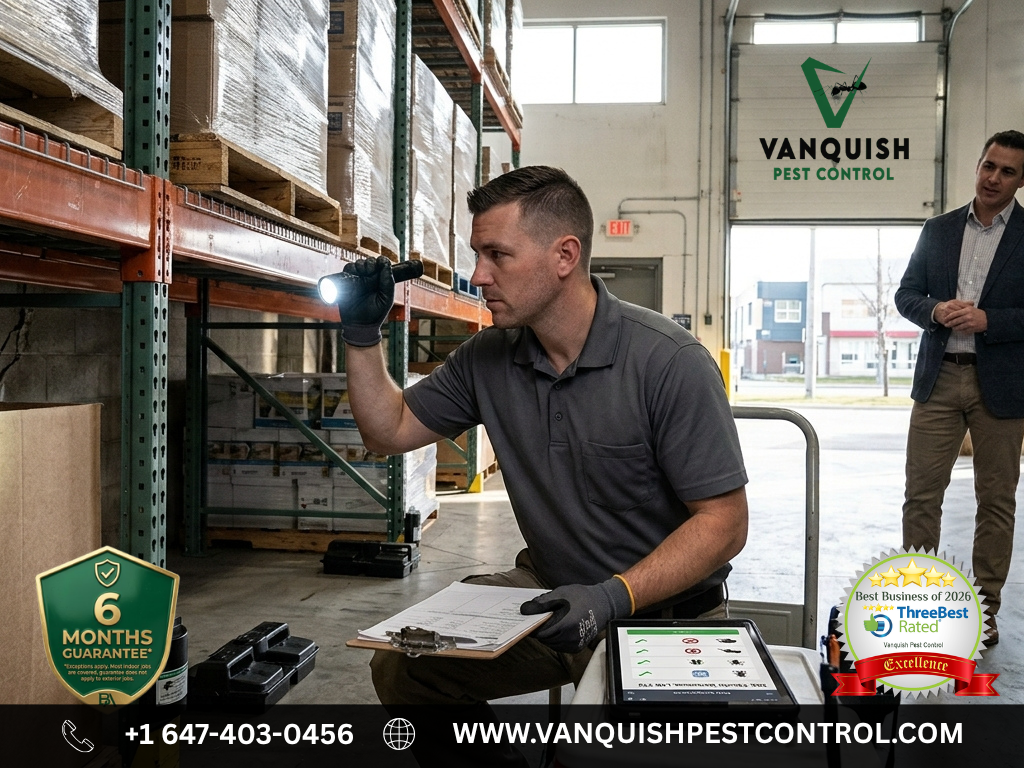
Commercial Pest Control for Warehouses
Warehouses face unique pest risks because of storage, deliveries, packaging, loading docks, and large floor areas.
Rodents can hide behind:
- Pallets
- Boxes
- Storage racks
- Equipment
- Stored materials
Incoming shipments can also introduce pests into facilities.
Regular inspection and monitoring can help identify activity before it becomes widespread.
Warehouse Pest Prevention
Businesses can reduce pest risks by:
- Keeping storage areas organized
- Reducing unnecessary clutter
- Maintaining clean floors
- Managing waste
- Inspecting incoming materials
- Keeping doors closed when possible
- Sealing structural openings
- Monitoring for rodent signs
Commercial Pest Control for Offices
Offices can experience pest problems even when there is no major food operation.
Common problem areas include:
- Break rooms
- Kitchens
- Coffee stations
- Garbage areas
- Storage rooms
- Basements
- Building entrances
Employees can unintentionally introduce pests through food, bags, boxes, and personal belongings.
A combination of good housekeeping and professional pest monitoring can help reduce these risks.
Commercial Pest Control for Retail Businesses
Retail stores deal with constant customer traffic and regular deliveries.
Doors frequently open, products move in and out, and storage areas may remain relatively undisturbed.
Potential pests include:
- Rodents
- Cockroaches
- Ants
- Flies
- Spiders
- Wasps
A professional inspection can identify vulnerabilities around entrances, storage rooms, receiving areas, garbage zones, and exterior walls.
What Causes Pest Infestations in Commercial Buildings?
Pest infestations usually develop when pests have access to the resources they need.
These commonly include:
Food
Food spills, ingredients, garbage, crumbs, and improperly stored products can attract pests.
Water
Leaks, condensation, drains, and standing water can provide moisture.
Shelter
Pests look for protected areas where they can hide and reproduce.
Entry Points
Small gaps around doors, pipes, foundations, vents, and utility lines can allow pests inside.
Clutter
Unnecessary storage and clutter can create harbourage areas.
Temperature
Commercial buildings provide protection from extreme outdoor temperatures.
How Do You Know If Your Business Has a Pest Problem?
You don’t necessarily need to see a large number of pests.
Look for warning signs such as:
- Droppings
- Damaged packaging
- Gnaw marks
- Live insects
- Dead insects
- Egg cases
- Shed skins
- Nests
- Webs
- Unusual smells
- Repeated pest sightings
- Scratching sounds
- Grease marks
Employees should know how to report pest sightings quickly.
Early reporting can make investigation and treatment easier.
Why Professional Pest Inspection Matters
A professional pest inspection can reveal problems that aren’t immediately obvious.
A technician may investigate:
- Pest entry points
- Harbourage locations
- Food sources
- Moisture
- Structural gaps
- Pest trails
- Nesting locations
- Sanitation concerns
For concealed infestations, inspection is particularly important.
A business may see wasps entering a brick opening without realizing that an entire colony is established inside the wall void.
Likewise, a restaurant may see fruit flies around a bar without realizing that the breeding source is located inside a drain or hidden organic buildup.
What Is Integrated Pest Management?
Integrated Pest Management, commonly called IPM, is a comprehensive approach to pest management.
Instead of relying exclusively on pesticides, IPM can combine:
- Inspection
- Identification
- Monitoring
- Sanitation
- Exclusion
- Habitat modification
- Targeted treatment
- Follow-up
The objective is to manage pests while addressing the environmental conditions that allow them to thrive.
For commercial properties, this can be particularly valuable because pest activity is often connected to building maintenance and daily operations.
Prevention Is Better Than Waiting for an Infestation
A reactive approach means waiting until the pest problem becomes obvious.
A proactive approach looks for risks before they become major problems.
Businesses can reduce pest risks by:
- Sealing gaps
- Managing garbage
- Maintaining clean food areas
- Fixing leaks
- Organizing storage
- Inspecting deliveries
- Maintaining doors and screens
- Reducing clutter
- Monitoring pest activity
Professional inspections can complement these internal procedures.
How Often Should a Business Have Pest Control?
There isn’t one schedule that works for every business.
Service frequency can depend on:
- Type of business
- Property size
- Pest history
- Food handling
- Building design
- Location
- Seasonal activity
- Previous infestations
- Pest pressure
- Monitoring results
A restaurant may require a different pest management schedule from an office.
A warehouse may have different risks from a multi-unit residential building.
A professional pest control provider can help determine an appropriate service frequency based on the property’s needs.
What Should Property Managers Do When a Tenant Reports Pests?
The first step is to take the report seriously.
Management should document:
- What pest was reported
- Where it was seen
- When it was seen
- Whether it has been seen repeatedly
- Whether neighbouring areas have similar complaints
Avoid assuming the issue is isolated until the situation has been assessed.
Depending on the pest, professional inspection may be necessary to determine the extent of the problem.
What Should Businesses Look for When Hiring a Pest Control Company?
Price shouldn’t be the only consideration.
Businesses should evaluate:
Commercial Experience
Does the company understand the requirements and challenges of commercial environments?
Proper Licensing
Businesses should ensure pest control services are provided in accordance with applicable Ontario requirements.
Ontario’s pesticide licensing framework establishes requirements for businesses and individuals conducting certain pesticide-related activities.
Inspection Process
Does the provider inspect the property before recommending treatment?
Documentation
Can the provider provide service records and recommendations?
Follow-Up
What happens after the initial treatment?
Prevention
Does the company identify conditions that could contribute to future pest activity?
Ontario Regulations and Commercial Pest Control
Businesses should understand that pest control in Ontario is subject to regulatory requirements.
Ontario regulates pesticide use and licensing, while pest control products are federally regulated in Canada.
Health Canada regulates pest control products under the Pest Control Products Act, and products must meet Canadian regulatory requirements before they can be used or sold.
Businesses should therefore work with appropriately qualified pest control professionals and ensure pest management practices comply with applicable requirements.
For food businesses, Ontario’s food-premises rules also establish specific pest-control and record-keeping requirements.
Seasonal Commercial Pest Control in Ontario
Ontario businesses experience different pest pressures throughout the year.
Spring
As temperatures rise, insect activity begins increasing.
Businesses should inspect:
- Exterior walls
- Doors
- Windows
- Landscaping
- Garbage areas
- Storage spaces
Summer
Summer can bring increased activity from:
- Wasps
- Hornets
- Flies
- Fruit flies
- Ants
- Spiders
Restaurants and businesses with patios may experience particularly noticeable insect activity.
Fall
As temperatures begin to decline, some pests may seek shelter inside buildings.
Rodent prevention becomes particularly important.
Inspect potential entry points around the building exterior.
Winter
Commercial buildings can still experience indoor pest activity.
Warm indoor environments can allow pests such as cockroaches and rodents to remain active.
This is why year-round monitoring can be more effective than waiting for seasonal infestations.
Why Hidden Pest Infestations Are Particularly Challenging
Visible pests are usually only part of the story.
A wasp nest may be hidden inside a brick wall.
Rodents may be moving through wall voids.
Cockroaches may be hiding beneath commercial equipment.
Bed bugs may be concealed inside furniture.
Fruit flies may be breeding in drains.
These situations require more than surface-level treatment.
Professional pest control focuses on finding the source of the activity and determining how the pest is using the property.
Professional Wasp Control for Difficult-to-Reach Nests
One example of specialized commercial pest management involves wasps nesting inside structural cavities.
A recent Vanquish Pest Control service involved a wasp hive hidden inside a void within a brick wall.
The nest was difficult to reach directly.
Instead of unnecessarily dismantling the brickwork, professional equipment was used to deliver an aerosol treatment through an appropriate opening at controlled high pressure.
This type of treatment demonstrates an important principle of professional pest management:
The visible location of pest activity isn’t always the actual location of the pest colony.
When pests establish themselves inside structural voids, professional assessment can help determine how to reach the infestation while minimizing unnecessary disruption to the property.
Businesses should never attempt to disturb an active wasp colony themselves.
Frequently Asked Questions About Commercial Pest Control in Ontario
What is commercial pest control?
Commercial pest control is the professional management of pests in businesses, restaurants, warehouses, offices, retail stores, rental properties, and other commercial facilities.
What pests are common in Ontario businesses?
Common pests include cockroaches, mice, rats, ants, fruit flies, flies, wasps, hornets, spiders, and bed bugs.
How can I prevent pests in my restaurant?
Keep food properly stored, manage garbage, clean spills, maintain drains, fix leaks, seal entry points, inspect deliveries, and use professional pest monitoring when appropriate.
How often should a commercial property receive pest control?
The ideal frequency depends on the property, pest pressure, industry, previous pest activity, building conditions, and monitoring results.
What should I do if I find a cockroach at my business?
Document where it was found and contact a pest professional for assessment, particularly if additional signs or sightings occur.
Can pests enter through brick walls?
Pests may access cavities, openings, cracks, and other structural voids associated with masonry and building construction. Repeated pest activity around one opening should be professionally assessed.
How do I know if wasps are nesting inside a wall?
Repeated wasp activity entering and exiting the same small opening can indicate a concealed nest. Don’t disturb the opening or nest yourself.
Can commercial pest control prevent infestations?
A proactive pest management program can help identify risks, monitor activity, address existing pests, and reduce conditions that support future infestations.
Is pest control regulated in Ontario?
Yes. Ontario has licensing and regulatory requirements for certain pesticide-related activities, and pest control products are federally regulated in Canada.
Do restaurants need pest control records?
Ontario’s food premises regulation requires records of pest control measures undertaken and specifies how long those records must be retained.
Why Choose Vanquish Pest Control for Commercial Pest Control?
Choosing the right pest control provider is an important decision for a business or property manager.
At Vanquish Pest Control, we understand that commercial pest problems can affect more than the building.
They can affect:
- Customers
- Employees
- Tenants
- Inventory
- Business operations
- Reputation
- Property management
Our approach focuses on understanding the pest problem rather than simply treating visible insects or rodents.
We provide professional pest management solutions for residential and commercial properties throughout Ontario, including pest control for:
- Restaurants
- Offices
- Warehouses
- Retail stores
- Rental properties
- Multi-unit buildings
- Commercial facilities
Our pest control services address common concerns such as cockroaches, rodents, ants, spiders, wasps, hornets, fruit flies, bed bugs, and other pests.
We also understand that some infestations are difficult to access.
From fruit flies breeding in hidden areas to wasp colonies concealed inside structural voids, professional pest management requires careful assessment and an appropriate treatment strategy.
Vanquish Pest Control is proud to have received recognition from ThreeBestRated, reflecting our commitment to quality service and customer satisfaction.
Final Thoughts on Commercial Pest Control in Ontario
Pest control shouldn’t be an afterthought for businesses and property managers.
A pest problem can begin quietly and become increasingly difficult to manage when it is ignored.
The best commercial pest management strategy is proactive.
Regular inspection, monitoring, sanitation, building maintenance, exclusion, employee awareness, and professional treatment can work together to reduce pest risks.
For restaurants, this is particularly important because food, water, waste, and daily operations can create ideal conditions for pests.
For property managers, prompt investigation of tenant complaints can help prevent pest problems from becoming larger building-wide concerns.
For warehouses and retail businesses, monitoring storage, deliveries, loading areas, and structural openings can reduce opportunities for pests to establish themselves.
And when pests are hidden inside difficult-to-reach areas such as a wasp hive inside a brick wall void professional equipment and expertise can make it possible to address the source without unnecessary structural disruption.
Vanquish Pest Control provides professional commercial pest control services in Ontario for businesses, property managers, restaurants, warehouses, offices, and other commercial properties.
If you’ve noticed pest activity or want to take a proactive approach to protecting your commercial property, contact Vanquish Pest Control for a professional assessment.
Don’t wait until a pest becomes a customer complaint. Identify the problem, address the source, and protect your business with professional commercial pest control in Ontario.